
Will Aftermarket Filters Void Your Tractor Warranty?
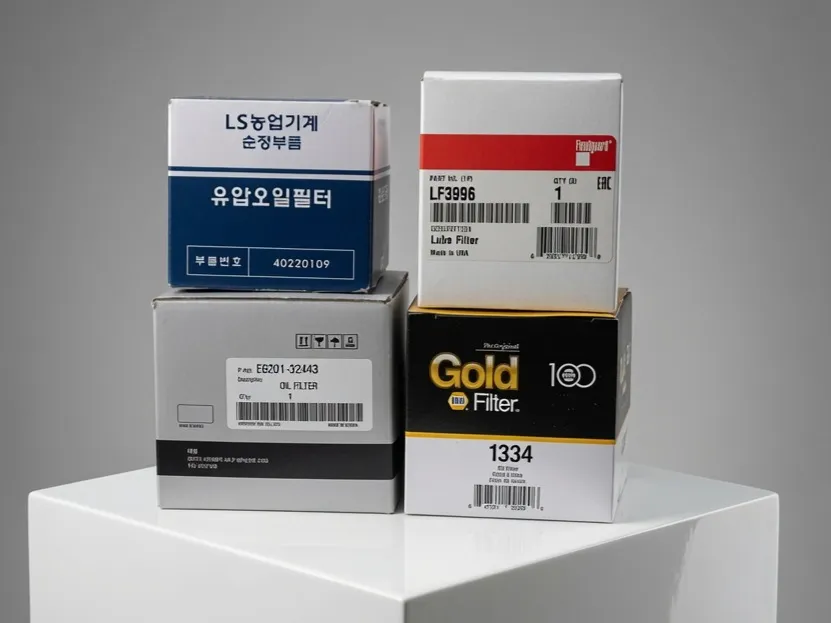
No. Running aftermarket filters doesn't void your tractor warranty. That's my understanding of it, anyway.
A manufacturer can't tie your warranty to buying their brand of maintenance items. Filters, oil, fluids. The warranty can't depend on the logo on the box.
What they can require is that whatever you use meets their specifications. And if the wrong part causes a failure, they can deny that claim. That's the whole game right there.
So the warranty question is really a filter question. Is the one you're buying actually right for your engine, and can anybody back that up?
Just about everybody who buys a new tractor from us asks me some version of this at the counter. Can I service this thing myself, with filters and fluids from the store in town, without screwing up my warranty? Yes, and here's how to do it without getting burned.
There are three pieces: the parts, the fluids, and who does the work.
The $13 filter everybody recommends
There's a conversation that comes up in the LS Facebook groups a whole bunch. Some of the OEM filters on these tractors are kind of expensive for what they are. So somebody asks, and somebody else answers: just run a NAPA 1515. (Don't do this!)
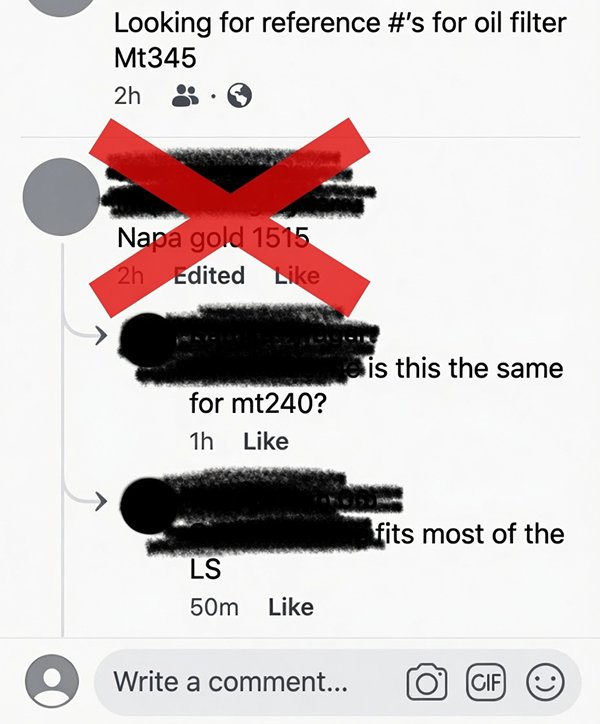
The LS oil filter number is 40409065 (it replaced 40318591). The 1515 screws right onto those engines, it's about $13, and every NAPA in the country has it on the shelf.
So I went and checked. Neither NAPA nor WIX lists a replacement for either LS number.
Then look at what NAPA says the 1515 does fit. It's quite a list: a '66 Shelby Cobra, a '58 Edsel, Datsun pickups, old Chryslers, Allis Chalmers gas tractors from the sixties.
It runs for pages. What you won't find anywhere on it is an LS diesel.
That's what a "will fit" filter is. The threads and the gasket are close enough to screw it on. Nobody who makes it has ever said it's right for your engine.
Recommending it to strangers? I wouldn't, warranty or not.
What are you actually guessing on?
Now, is that filter hurting anything? Honestly, I'm out of my wheelhouse here. But that filter was designed around gas engines from the sixties.
A tractor diesel runs heavier oil than just about any modern gas engine, and cold, you've got 40 PSI at an idle. Is that filter's bypass just open the entire time? I don't know, and neither does the guy in the Facebook group.
The media, the bypass setting, the flow. You're guessing on all of it.
I can't tell you the 1515 would hurt that engine. What I can tell you is that if the engine fails under warranty, the OEM can pretty easily say you were running a filter that doesn't meet their specifications.
How I pick an aftermarket filter
Take the correct OEM part number and type it into the filter manufacturer's own interchange. WIX, Fleetguard, Baldwin, whoever you're buying. If they list a replacement for that number, you're okay.
Because now, if there's ever a question, the filter company has to defend why they say it meets spec, or the OEM has to prove it doesn't. That doesn't make a dispute disappear. But you're standing there with a published catalog listing instead of a shrug.
Where you get on shaky ground is chaining crosses.
Say WIX gives you a number, but you can't find that filter anywhere local. So you take the WIX number, run it through Baldwin's interchange, and buy whatever comes out. Don't do that.
Go back to the original OEM number and put it straight into Baldwin. If Baldwin lists one, now you're okay. If nobody lists one, that's your answer too.
The two filters that taught me to check
I learned to be careful with cross-references many years ago, when I worked a truck parts counter at a Fleetguard dealer.
There were certain filters where you'd cross a NAPA or WIX number to Fleetguard and get two totally different filters. The one I remember is the WIX 51970.
Cross that number to Fleetguard and you had to know what the engine was before you could hand the guy a filter. A Big Cam Cummins got the LF670. An old two-cycle Detroit got the LF3333.
People would look at you funny. There's the filter number, right there. And it's like, yes, and it's two totally different filters, one for each engine.
That taught me these cross-references aren't gospel.
Nothing against NAPA or WIX filters. We use them.
Why bother with aftermarket at all
Cost, for one. I won't buy a $13 filter at NAPA when I've got OEM on the shelf, but plenty of people do, and I don't blame them. If the OEM filter is $35 and you have to get it shipped or drive a distance for it, I get it.
Availability is the bigger one. There are way more NAPA and O'Reilly stores in this country than LS or KIOTI dealers. If your town doesn't have a tractor dealer, it probably has a parts store.
Here's how it shakes out at our own shop. If it's a brand we sell, it gets OEM filters. We stock them, so there's no reason not to.
On brands we don't sell, it depends on price, availability, and what the machine is.
My own equipment runs mostly OEM too. The exceptions are a Fleetguard oil filter and air filter on my pickup, and Fleetguard or Donaldson air filters on the tractors. I still buy them from the parts house I used to work at, because I think Fleetguard makes a good filter.
Who actually checks your service records
Doing the work yourself, or having a shop that isn't a dealer do it, is fine. Use the right fluids and filters at the right intervals, and write down what you did and when.
Keep those records. I've personally never had a manufacturer ask us for a customer's maintenance records, but "hasn't yet" isn't "never will." If there's ever a question, that paper is your friend.
Here's the other thing to know. On a serious failure, an engine, say, what we've seen is the manufacturer doesn't start with paperwork. They have us pull oil, fuel, and coolant samples and send them to a lab.
If the oil comes back fuel-contaminated or the soot level is off the charts, that's what they're going to go by. Your records and your oil need to tell the same story. The only way to guarantee that is to actually do the maintenance.
And keep some perspective. The tractor company doesn't wake up in the morning looking for people who used the wrong filter so it can void warranties. This only ever comes up when something big breaks and somebody wants it covered.
Fluids are the easy part
The operator's manual publishes a spec, and sometimes examples. The book might list Shell Spirax S4, which doesn't mean much to anybody in North America.
But if it calls for a J20C hydraulic fluid, you just have to buy a fluid that meets J20C. Any brand. That's it.
That's the difference between fluids and filters, by the way. A fluid has a published spec you can read and match. A filter mostly doesn't, which is why the filter maker's own catalog listing is your evidence.
I went deeper on this in my universal tractor fluid article if you want the full story on fluids.
Where I land
Aftermarket filters are fine. I use them. But make the filter company put its name on the application.
Type your OEM number into their interchange. If they list a replacement, buy it and keep the receipt. If nobody lists one, buy the OEM filter and grumble about the price like the rest of us.
Related Reading
Written by Jeremy Linder
I grew up on a working farm with parents who manufactured machinery. I've been selling tractors and implements since 2014, and I run my own 20 acres plus help manage our family's 200-acre beef operation. Everything I recommend is something I'd put on my own property.
Get equipment tips in your inbox
No spam. Unsubscribe anytime.
Check your inbox
We just sent you a confirmation email. Click the link inside and you're in.