
Best Mower for Hills: Why I Put People on Steering-Wheel Zero-Turns
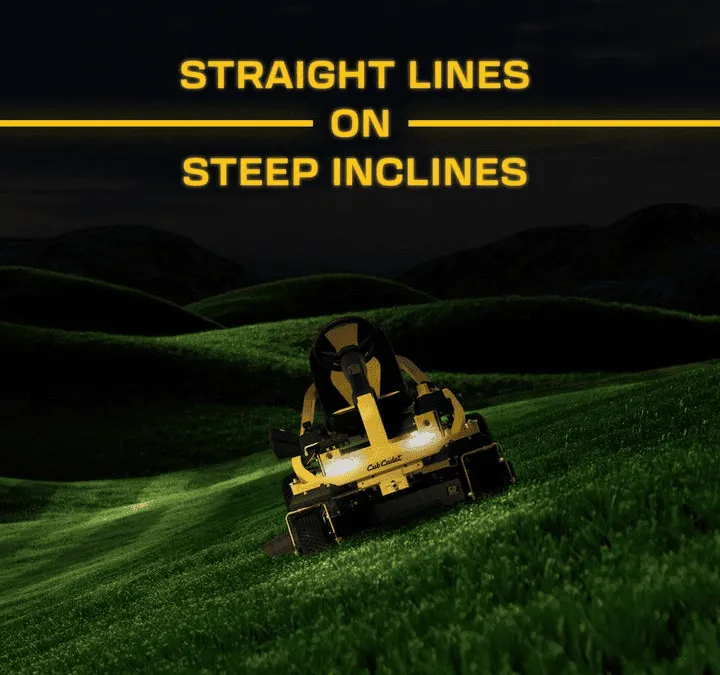
If you've got hills and you're shopping for a riding mower, my answer is a steering-wheel zero-turn. In my experience, nothing else you can readily buy is as controlled or as confidence-inspiring on a slope.
There are two trade-offs: it costs more than the lap-bar version of the same mower, and there's more going on in the steering. I'll cover both. But we sell more of these every year, and I can't think of a customer who regretted the upgrade.
Dealer note: We sell and service Cub Cadet at AG-BAG Forage Solutions. The opinions here come from selling these machines, from what customers tell us, and from running them at home.
Most of my hill customers are coming off a lawn tractor
The most common upgrade I see is from a lawn tractor to a steering-wheel zero-turn. People around here have mowed slopes with lawn tractors forever. They hang half off the seat on the uphill side, put traction tires on, and mow ground they really shouldn't be on.
I know because I did it. Our yard has a couple of pretty steep spots. On the lawn tractor, I had to have half my butt hanging off the uphill side of the seat to give myself a chance of not tipping over. It was sketchy, and eventually I decided it wasn't a good idea.
I already knew the steering-wheel Cubs were good, so I bought my wife one, a Z-Force S 48. Before she ever got on it, I took it to the sketchiest spot in our yard to see what it would do. It was absolutely fine. Later she wanted a bigger mower, and today we run a Pro Z 960S.
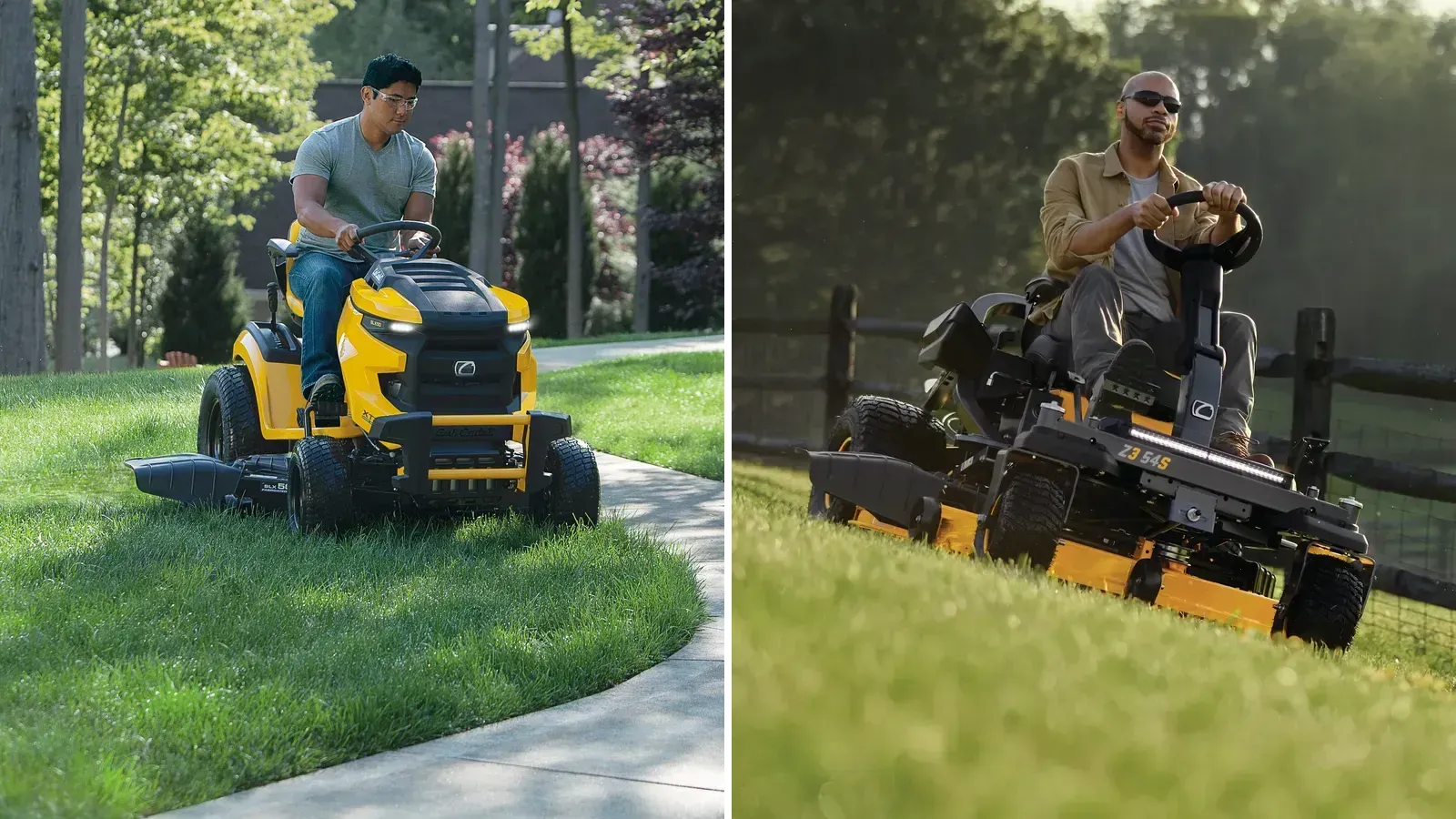
If you're comfortable on a lawn tractor, the learning curve on a steering-wheel zero-turn is basically zero. You steer with a wheel and drive with foot pedals. That's also why I sell some of these to people with no hills at all. They tried lap bars and didn't like them, or the lap bars intimidated them.
Still deciding between a zero-turn and a lawn tractor at all? Read our zero-turn vs. lawn tractor guide.
Why a steering wheel helps on a sidehill
On a regular lap-bar zero-turn, the front wheels are casters. Nobody steers them. On a sidehill they want to drift downhill, so you keep feathering the lap bars to hold your line.
On a Cub Cadet steering-wheel zero-turn (Cub calls it Synchro-Steer), the steering wheel turns the front wheels. Linkage runs back to the drives, which speed up or slow down each rear wheel to match. Turn sharp enough and the inside rear wheel actually reverses, which Cub describes as the rear wheels counter-rotating. Only the rear wheels are driven. "Four-wheel control" means all four wheels are working together on the steering, not four-wheel drive.
The result is that the front end goes where you point it. On a hill you hold your line instead of fighting it. These machines also sit low and wide, and in my experience they just do awesome on hills.
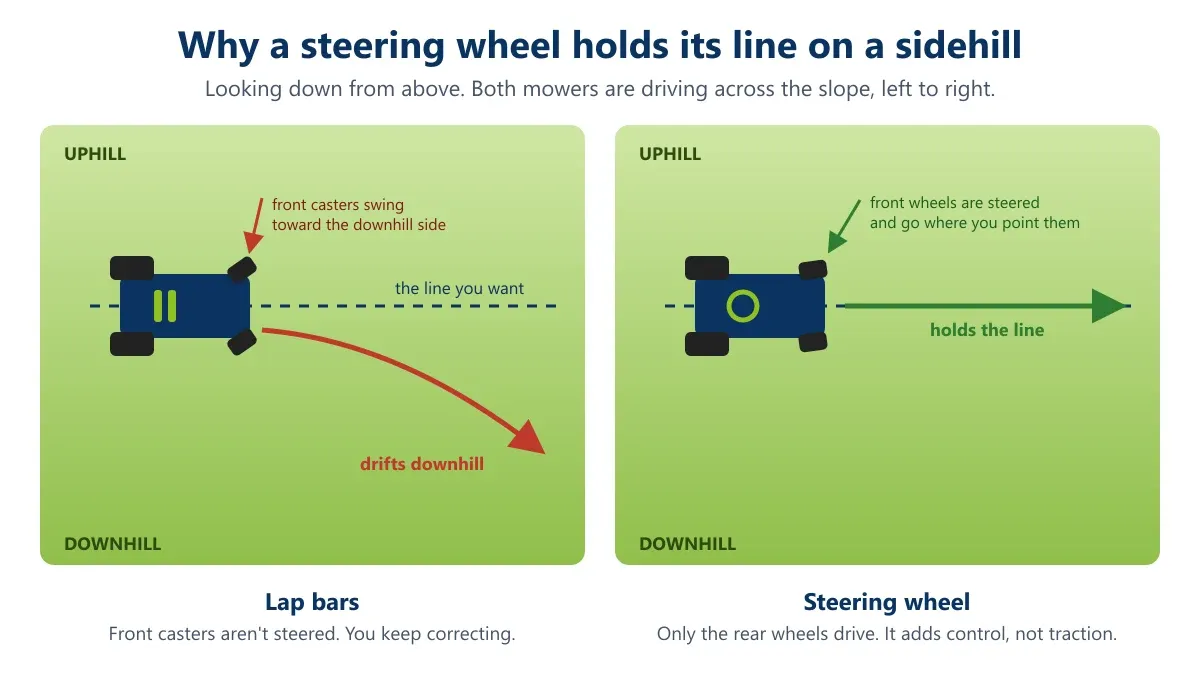
Cub's own ratings back this up. In the same mower family, the lap-bar Ultima Z3 50 is rated for slopes up to 15°, and the steering-wheel Z3 50S is rated up to 20°. Same deck size, same family, 5° more slope for the steering.
There's an efficiency gain too. A Cub Cadet rep told me this years ago, and Cub Cadet Canada says it on their site: the steering cuts overlap and gives about a 10% reduction in mowing time compared to the same lap-bar Ultima. Cub doesn't publish how they measured that, so take it as their claim. What I can tell you is that holding a straight line is a lot easier with a wheel.
What customers tell us after they switch
Three customers who made the switch:
About three acres, coming off a Husqvarna rider. She mows an honest three acres, maybe a little more, with some pretty sloped areas. On the old rider she white-knuckled the steep stuff, and in her words it took forever. A year ago she bought a 50-inch steering-wheel Ultima (the ZTS2 50; Cub has since renamed that line, and today's version is the Z3 50S). She doesn't white-knuckle the steep spots anymore, and between that and zero-turn speed, her mowing time dropped a lot.
A longtime John Deere lawn tractor owner. He'd had the Deere forever and was apprehensive about switching. Last year he finally bought a Z3 50S. He cut his mowing time, and he now mows areas the lawn tractor couldn't handle because of the slope. That's a bunch of ground he no longer has to string-trim.
A couple running two big John Deere tractors. They each mowed on a nearly garden-tractor-size Deere, and it took the two of them about six hours. They had quite a bit of slope, and handling it better was one big reason they came in. Comfort was the other. They bought a Pro Z 960S, and its air-ride seat is super cushy. Now one person mows the whole place.
Which steering-wheel model to buy
It works like every other mower line: you're paying for the hours of service you'll get out of it. The heavier-duty the machine, the longer it lasts and the more abuse it takes.
Model | Slope | ROPS | MSRP |
|---|---|---|---|
Ultima Z3 50S | 20° | No | $6,099 |
Ultima ZTXS4 54 | 20° | Yes | $8,990 |
Ultima ZTXS5 54 | 20° | Yes | $10,544 |
Ultima ZTXS6 60 | 20° | Yes | $11,876 |
Pro Z 760S, 60" | 20° | Yes | $16,538 |
Pro Z 960S EFI, 60" | 20° | Yes | $18,869 |
Pro Z 972SD EFI, 72" | 25° | Yes | $25,418 |
MSRP is from Cub Cadet's 2027 price schedule, effective October 1, 2026. Slope ratings, ROPS and warranty come from Cub Cadet's product pages and operator's manuals. The ZTXS models also come in 48-inch and 60-inch decks. Call or text us for today's price.
Z3 50S. Where our steering-wheel lineup starts, and the model two of the customers above bought, in its current and older versions. It's a good fit for a typical hilly acreage where the budget matters, and it's the most affordable way into a steering wheel. It runs a 23 HP Kawasaki, carries a 3-year warranty with unlimited hours, and has no ROPS.
ZTXS4, 5 and 6. A step up in drives and deck, ROPS, and a 4-year or 800-hour warranty. Engines run 24 to 26 HP, Kawasaki or Rehlko (formerly Kohler) depending on the model. For most homeowners with real hills and more ground to cover, this is where I'd start looking.
Pro Z S models. Commercial machines, and honestly, not everybody needs one. Cub Cadet has really upped their game over the past 10 years, and their commercial mowers are top notch. I first saw one of the early Pro Zs at a Cub Cadet event PES held in Salem. It was built really well, and it was heavy duty. They run Kawasaki FX engines, 31 HP on the 760S and 38.5 HP on the 960S, and Cub's warranty is 3 years with no hour limit and/or 5 years or 1,200 hours.
This year we sold six Pro Zs to homeowners. Word gets around: you sell one, and the neighbors see it. Most of those buyers told us some version of "I want a good mower, I'm tired of the ones that fall apart after four or five years," or "I've got hills."
Pro Z 972SD. The dual-rear-wheel version, rated to 25°. It's built mainly for municipalities and commercial crews with big slopes. Most homeowners don't need it.
The downsides
Price. In the same family, the lap-bar Z3 50 is $5,099 and the Z3 50S is $6,099, so the steering costs about $1,000 (Cub Cadet MSRP, effective October 1, 2026).
More going on in the steering. You're steering the front wheels, and linkage runs back to tell the rear drives what to do. It's more parts than lap bars. In our shop we don't have much trouble with it. The main thing is keeping grass and debris from building up under there and causing problems. Most of it isn't stuff that wears out.
The Pro Z is heavy and thirsty. Cub lists the Pro Z 960S at 1,580 pounds. An XT1 lawn tractor is roughly 400 to 520 pounds, depending on the version. The Kawasaki FX1000 absolutely rips, but it burns a lot of gas. Commercial machines also cost more to maintain, and their parts cost more. In exchange you get a longer warranty and components that last a long time.
Towing is limited. If you pull a cart a lot, read the towing limits. The Z3 50S and ZTXS manuals cap towing at 250 pounds rolling weight and 50 pounds tongue weight, with no towing on slopes over 5°. If towing is a big part of your mowing day, keep the lawn tractor for that job.
Hill safety: what the manual says
A steering wheel gives you better control. It doesn't change the rules in your operator's manual.
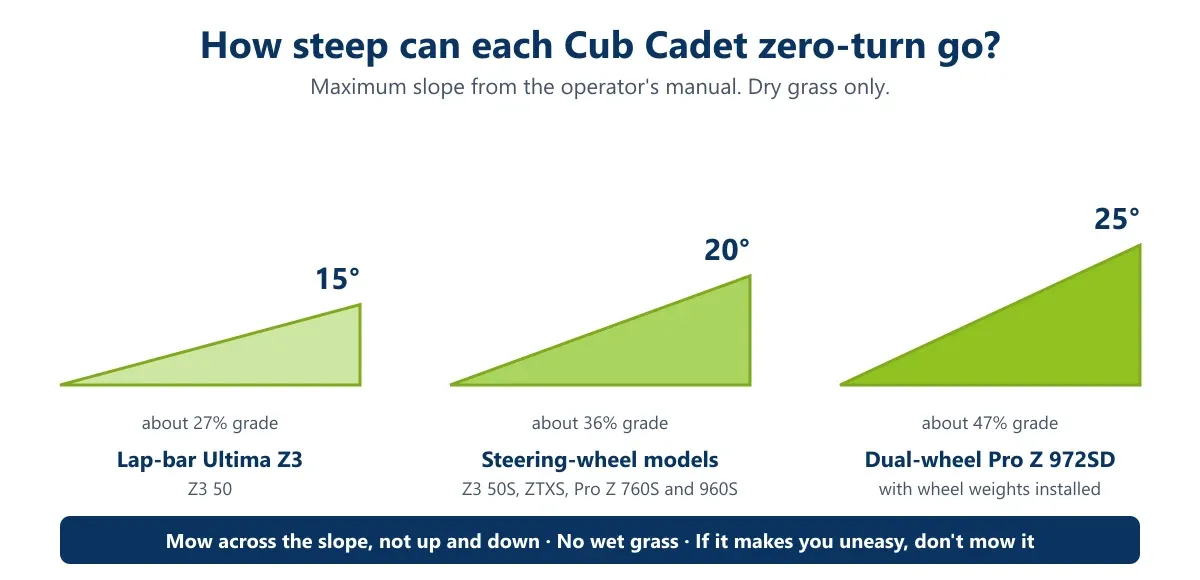
For the Cub Cadet zero-turns in this article, the manuals say:
- Stay under the rated slope. That's 15° for the lap-bar Z3, 20° for the Z3 S, ZTXS and Pro Z S models, and 25° for the 972SD.
- Mow across the slope, not up and down. If you're mowing a slope, start at the bottom and work upward so your turns are made uphill.
- Don't mow on wet grass. Reduced traction could cause sliding or a loss of control.
- Keep all movement on slopes slow and gradual. Use low speeds, avoid sudden turns, and avoid starting and stopping on slopes.
- Don't use a grass catcher on slopes over 10°.
- On machines with ROPS, keep the roll bar up and your seat belt fastened. Lower it, and leave the belt unfastened, only in low-clearance spots. Raise it and fasten the belt as soon as clearance permits.
- If you can't back up the slope, or you feel uneasy on it, don't mow it.
Around here, the wet-grass rule means picking your days. A slope that's fine in July can be a different story in a wet spring.
Other machines have their own rules. Lawn tractors and walk-behinds have their own slope ratings and their own instructions on mowing direction, so read the manual for the machine you own. If you've got a spot you're not sure about, call us before you buy, not after.
Read the full safety rules in your Cub Cadet operator's manual:
- Ultima Z3 lap-bar (Z3 50)
- Ultima Z3 S (Z3 50S)
- Ultima ZTXS series
- Pro Z 760S and 960S EFI
- Pro Z 972SD EFI
Northwest buyers
- We sell and service what we sell.
- We know wet grass, clay and steep ground, and we'll tell you if a spot on your place is a bad idea for any riding mower.
- Oregon has no sales tax, which often means a lower out-the-door price for out-of-state buyers. You're responsible for any use-tax reporting in your home state.
See our mower lineup and Cub Cadet page, or call or text us at 503-325-2970. Tell us about your worst hill, not your easiest one.
FAQ
What is the best mower for hills?
For most homeowners, a steering-wheel zero-turn. It steers the front wheels instead of letting casters drift, so it holds a line on a sidehill. Cub Cadet rates its steering-wheel Ultima and Pro Z S models for slopes up to 20°, compared with 15° for the lap-bar Z3.
Is a steering-wheel zero-turn better than lap bars on hills?
In our experience, yes. The front wheels go where you point them instead of drifting downhill. Cub Cadet backs that up with a higher slope rating, 20° vs 15° on the Z3 family.
Is a steering-wheel zero-turn hard to learn?
Not if you've driven a lawn tractor. You steer with a wheel and control speed with foot pedals. Most people are comfortable right away.
Is a steering-wheel zero-turn worth about $1,000 more than a lap-bar?
If you have hills, or you just don't like lap bars, we think so. You get better control on slopes, an easier time holding a straight line, and Cub Cadet claims about 10% less mowing time.
Do I need a commercial Pro Z for my property?
Usually not. Buy a Pro Z if you want a machine built to last a long time and take abuse, and you're fine with the weight, fuel use and maintenance cost. The 972SD with dual rear wheels is built mainly for municipalities.
Can I tow with a steering-wheel zero-turn?
Light loads only. The Z3 50S and ZTXS manuals list 250 pounds rolling weight and 50 pounds tongue weight, with no towing on slopes over 5°. If you tow a lot, a lawn tractor is the better tool for that job.
Can I mow my hill when the grass is wet?
No. The Cub Cadet zero-turn manuals say not to mow wet grass because you can lose traction and slide.
How steep a hill can a zero-turn mow?
It depends on the exact model, so check the manual. On Cub Cadet: 15° for the lap-bar Z3, 20° for the steering-wheel Ultima and Pro Z S models, and 25° for the dual-wheel Pro Z 972SD. If a slope makes you uneasy, don't mow it.
Related Reading
Written by Jeremy Linder
I grew up on a working farm with parents who manufactured machinery. I've been selling tractors and implements since 2014, and I run my own 20 acres plus help manage our family's 200-acre beef operation. Everything I recommend is something I'd put on my own property.
Get equipment tips in your inbox
No spam. Unsubscribe anytime.
Check your inbox
We just sent you a confirmation email. Click the link inside and you're in.