
0% tractor financing or a cash rebate? Your down payment can change the answer
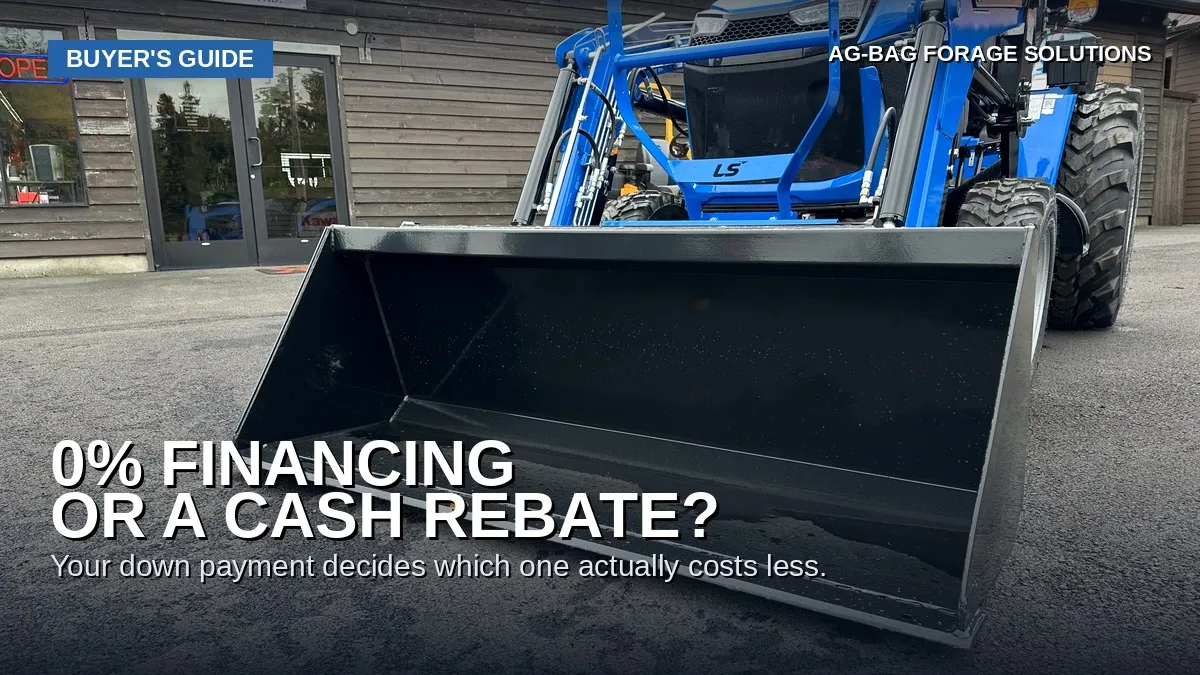
In the illustrative LS tractor comparison below, 0% financing costs less with nothing down. Put $5,000 down on the same tractor, and the cash rebate with a standard-rate loan costs less over the full term. The 0% loan still has the lower monthly payment.
When a low-rate offer requires you to give up a cash rebate, you are comparing two prices as well as two loans. Put both offers on paper before deciding which one costs less.
In this example, the rebate is passed through to you. I can explain the numbers, but you decide which payment and total cost work better for you.
What the two offers mean
With subsidized financing, you get a special low rate but give up the cash rebate. The standard-rate option lets you take the rebate, start with a lower tractor price, and pay interest on the amount financed. LS's cash rebate terms explain that the rebate cannot be combined with its subsidized financing.
Neither option automatically wins. The rebate, interest rate, loan length, down payment, lender fees, and expected payoff date can all change the answer. The cheaper offer can also have the higher monthly payment because the loan is shorter.
An LS MT242H worked example
This illustration uses AG-BAG's August 28, 2026 listed prices for an LS MT242H Tractor & Loader, with the historical rate inputs below. It assumes the full package balance can be financed at each rate to show how the math works. It is not a verified financing offer for that package. Confirm eligible equipment and current terms before using the calculation for a purchase.
Item | Special-rate offer | Rebate with standard financing |
|---|---|---|
Tractor & Loader price | $36,425 | $30,425 |
Stated interest rate | 0% | 5.75% |
Loan term | 120 months | 84 months |
Estimated lender fees added to the loan | $200 | $200 |
The rate inputs came from the August ACUSI program. The approximately $200 lender origination and filing fee was our estimate for this comparison, not an AG-BAG charge. The calculation includes that fee in each loan balance. On the standard-rate loan, it earns interest along with the rest of the balance.
This example uses a seven-year standard-rate loan. The August program listed 5.75% for terms up to 84 months. A shorter term at the same rate would mean a higher payment and less total interest, so compare the available terms that fit your budget. The 0% loan spreads payments over ten years.
These estimates exclude taxes and other buyer-specific charges. They assume fixed rates, monthly amortization, and every scheduled payment made on time. The stated interest rates are calculation inputs; APR can differ when required lender fees apply.
This dated example is not a current financing offer or credit commitment. Financing is subject to credit approval, lender and dealer participation, eligible equipment, and availability. Down payment, fees, and terms may vary. Confirm the treatment of the loader and other attachments in your own quote: LS's public special-rate terms exclude the loader, mower, and backhoe. Confirm current rates, exclusions, and expiration with the dealer and lender before buying.
Down payment | 0% for 120 months | Rebate at 5.75% for 84 months | Lower estimated total cost |
|---|---|---|---|
$0 | $305.21/month; $36,625 total | $443.73/month; $37,273 total | 0% by about $648 |
$5,000 | $263.54/month; $36,625 total | $371.28/month; $36,188 total | Rebate by about $437 |
$10,000 | $221.88/month; $36,625 total | $298.84/month; $35,102 total | Rebate by about $1,523 |
Total cost includes the down payment plus all loan payments. Totals are rounded to whole dollars from unrounded calculations; payments are rounded to cents for display. The lender fee is an estimate.
With nothing down, 0% wins on both payment and total cost. At $5,000 down, the rebate saves about $437, but requires about $108 more each month. At $10,000 down, the rebate saves about $1,523. The 0% payment is still lower.
Why the down payment changes the answer
Under the 0% offer, you give up the $6,000 rebate at the start. Money down lowers the monthly payment, but the purchase price stays the same.
The rebate route starts $6,000 lower. A larger down payment reduces the balance that earns interest. With equal fees in this example, that route costs less once its total interest falls below the $6,000 rebate.
Payoff timing matters too. On a simple-interest loan, paying down the balance sooner reduces interest. Other loan structures can work differently. If you expect to pay early, check the lender's early-payment rules and any prepayment charge. Paying off the 0% loan does not restore the rebate you gave up when you bought the tractor. The CFPB explains the difference between simple and precomputed interest.
I wrote out a similar comparison for a subcompact customer. His choice was 0% for 72 months or a free loader with standard financing. Even if he kept the standard loan for the full term, the free-loader offer came out roughly $1,000 ahead by my calculation.
He looked at the paper and said, "Well, shoot, the zero percent's free money." He chose 0% anyway.
Compare your own offers
Use our offer-comparison calculator to compare monthly payments and full-term costs with your own prices, rates, down payment, and lender fees.
Start with the dealer's price under each offer for the same tractor and equipment package. Get the available rate and loan length, and confirm fees and qualifications with the lender. Then use a loan calculator to compare the options with the down payment you actually plan to make.
For a regular fixed-rate loan, enter the amount you would borrow, the stated interest rate, and the number of months. Include fees added to the loan in the amount borrowed. Run the calculation once for each offer.
You only need to compare two results:
- Monthly payment: Can you comfortably afford it? A cheaper total does not help if the payment stretches your budget too far.
- Estimated total cost: Multiply the monthly payment by the number of payments, then add your down payment and any fees paid up front. Do not add financed fees again. This gives you a simple full-term comparison; the lender's final payment schedule may differ slightly because of rounding.
Use the same down payment and trade in both calculations. If you have a trade, its allowance minus what you still owe is your equity. Positive equity reduces what you borrow, but it is still value you put into the purchase, so include it with your down payment when comparing total cost. Any remaining trade debt rolled into the loan belongs in the amount borrowed.
If you plan to pay off early, use a calculator that supports extra payments and compare both options using the same payoff plan. Check the lender's rules first. The full-term total will not tell you what an early payoff costs.
Choose the lower total cost if the payment fits your budget. If keeping the payment lower or holding on to more cash matters more to you, look at how much extra that choice costs. That is the decision the numbers help you make.
Related Reading
Written by Jeremy Linder
I grew up on a working farm with parents who manufactured machinery. I've been selling tractors and implements since 2014, and I run my own 20 acres plus help manage our family's 200-acre beef operation. Everything I recommend is something I'd put on my own property.
Get equipment tips in your inbox
No spam. Unsubscribe anytime.
Check your inbox
We just sent you a confirmation email. Click the link inside and you're in.