
Universal Tractor Fluid Explained: What to Buy for Your Compact Tractor
TL;DR:
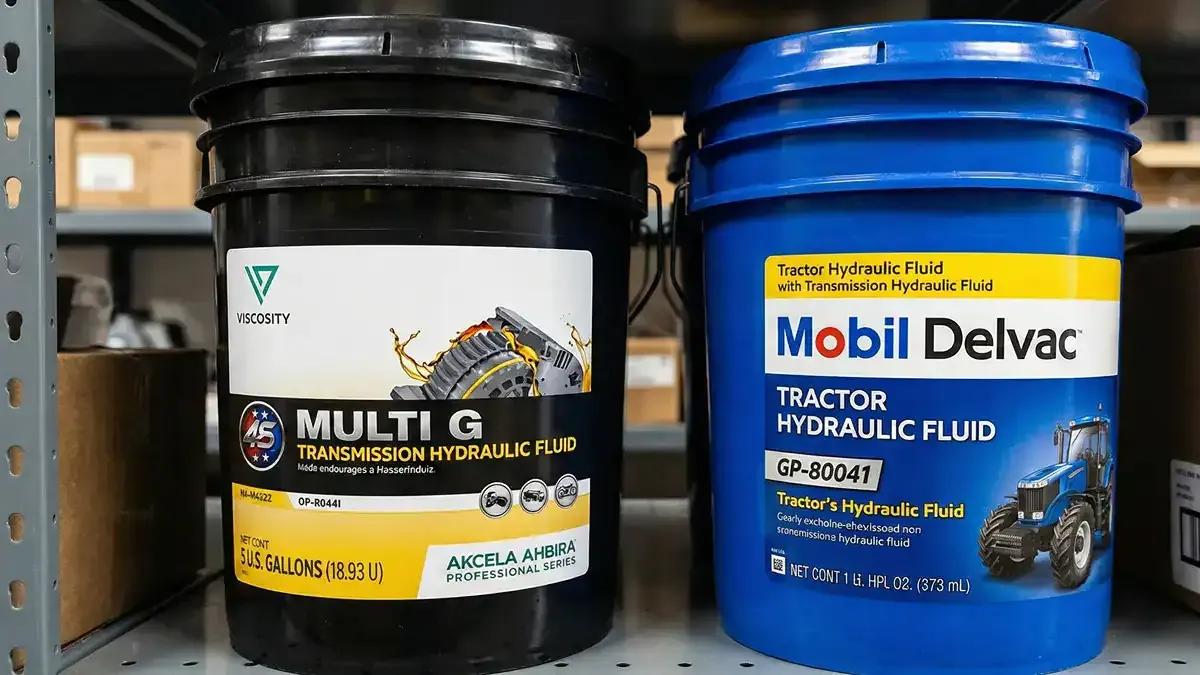
Your KIOTI or LS manual lists “ISO 68” or “API GL-4 ISO VG 32/46” — that’s a specification, not a product name. What you need is universal tractor fluid (UTF) meeting J20C standards. Mobilfluid 424, Mobil Delvac™ Tractor Hydraulic Fluid, and Viscosity UTF all work. Skip the bargain-bin options — brake chatter and sluggish hydraulics aren’t worth saving $15.
Why Your Tractor Uses Universal Tractor Fluid
Compact tractors use a common reservoir for multiple systems. Your transmission, hydraulics, wet brakes, and power steering all share the same fluid. That’s why you can’t grab a jug of standard hydraulic oil — you need a multi-functional fluid formulated to handle four different jobs simultaneously.
Universal tractor fluid contains a carefully balanced additive package: extreme pressure additives for gear protection, friction modifiers for wet brake compatibility, anti-wear properties for the hydraulic pump, and corrosion inhibitors to guard against rust and water contamination.
Regular hydraulic oil lacks the friction modifiers your wet brakes need. Use it, and you’ll get brake chatter — that grabbing, shuddering feeling when you press the pedal. I’ve seen customers come in after someone told them “all hydraulic fluid is the same.” Flushing the system and refilling with proper UTF usually fixes it, but that’s an expensive lesson when you’re looking at 8-15 gallons.
What Your Manual Specifications Mean
Your owner’s manual lists something like “API GL-4 ISO VG 32/46” for the transmission. That describes the fluid’s properties — it’s not a product name.
ISO VG 32/46 or ISO 68 refers to viscosity grade. It describes thickness at operating temperature and affects pumpability in cold weather.
API GL-4 is a gear oil classification ensuring protection under pressure.
J20C is the John Deere specification that became the industry standard. If a UTF meets J20C, it meets the ISO and API specs your manual lists.
Any quality universal tractor fluid meeting J20C works in KIOTI, LS, Kubota, and Deere compact tractors. You’re not locked into OEM products.
Universal Tractor Fluid vs. Hydraulic Oil
This distinction matters because using the wrong fluid causes real problems.
Hydraulic oil (like AW46 or AW68) is designed for industrial equipment — presses, log splitters, and machinery where the fluid only transmits power. These products lack friction modifiers because there are no wet brakes in those systems.
Universal tractor fluid is engineered for farm equipment where one reservoir serves multiple functions. It provides thermal stability across temperature ranges, good cold-weather flow characteristics, oxidation resistance for long service life, and the frictional properties your power brake system requires.
Put the wrong product in your tractor and you’ll notice problems quickly. Brake chatter comes first, then sluggish hydraulics. Over time, seals may start leaking because the fluid chemistry doesn’t match what they were designed for.
KIOTI Tractor Fluid Guide
KIOTI specifies UTF meeting J20C standards. Any quality product works and won’t affect your warranty.
KIOTI Capacities by Model
The capacity covers hydraulics, steering, wet brakes, and the gearbox — everything draws from the common reservoir.
CS Series (Sub-Compact)
Model | Capacity |
|---|---|
CS2210, CS2510 | 3.4 gal (13.6 qt) |
CS2220, CS2520 | 2.8 gal (11.2 qt) |
CX Series (Compact)
Model | Capacity |
|---|---|
CX2510 HST | 5.4 gal (21.6 qt) |
CX2510 Gear | 6.2 gal (24.8 qt) |
CK Series (Compact)
Model | Capacity |
|---|---|
CK2610, CK2620 | 5.3 gal (21.2 qt) |
CK3510, CK3520, CK4010, CK4020 | 5.8 gal (23.2 qt) |
DK Series (Compact)
Model | Capacity |
|---|---|
DK4210 – DK6010 (all SE variants) | 11.4 gal (45.6 qt) |
NS Series (Compact Utility)
Model | Capacity |
|---|---|
NS4710, NS5310H, NS6010 | 9.5 gal (38 qt) |
NX Series (Compact Utility)
Model | Capacity |
|---|---|
NX4510 – NX6010 | 11.9-14.5 gal (varies by engine) |
RX Series (Utility)
Model | Capacity |
|---|---|
RX6020, RX6620, RX7320, RX7620 | 15.9 gal (63.6 qt) |
RX6640, RX7340 | 15.7 gal (62.8 qt) revised Nov. 2025 |
HX Series (Utility)
Model | Capacity |
|---|---|
HX9010PC, HX1151PC | 20.3 gal (81.2 qt) |
HX1401 | 20.6 gal (82.4 qt) |
LS Tractor Fluid Guide
LS specifies API GL-4 ISO VG 32/46 — the same J20C specification. Any quality UTF works.
Some larger LS models specify ISO VG 46/68 — slightly heavier viscosity for bigger systems. Buy the grade your manual specifies.
LS Capacities by Model
MT1 Series (Sub-Compact)
Model | Capacity |
|---|---|
MT122, MT125 | 3.3 gal (12.5 L) |
XJ/MT2S Series (Small Compact)
Model | Capacity |
|---|---|
XJ2025 (Gear) | 6.3 gal (24 L) |
XJ2025H (HST) | 5.3 gal (20 L) |
MT225S | 4.5 gal (17 L) |
MT225E, MT225HE | 8.5 gal (32 L) |
MT2E/MT2 Series (Compact)
Model | Capacity |
|---|---|
MT2E, XG3000, XG3100, XG3025 | 8.5 gal (32 L) |
MT3/MT3E Series (Compact)
Model | Capacity |
|---|---|
MT3 (MT342, MT347, MT352, MT357) | 11.4 gal (43 L) |
MT3E | 9.8 gal (37 L) |
XR Series (Compact)
Model | Capacity |
|---|---|
XR3000, XR3032, XR3037, XR3100 | 7.9 gal (30 L) |
XR4000, XR4100 | 11.4 gal (43 L) |
MT5/MT7 Series (Utility)
Model | Capacity |
|---|---|
MT563, MT568, MT573, MT7101 | 14.5 gal (55 L) |
XU Series (Utility)
Model | Capacity |
|---|---|
XU5000, XU5055, XU5065 | 12.4 gal (47 L) |
XU6100, XU6158, XU6163, XU6168 | 12.4 gal (47 L) |
XP Series (Utility)
Model | Capacity |
|---|---|
XP8084, XP8094, XP8101 | 14.5 gal (55 L) |
What to Buy
What We Stock
We carry Viscosity Oil UTF or Mobil Delvac™ Tractor Hydraulic Fluid, depending on availability. Both meet J20C specifications. Expect about $80 per 5-gallon bucket.
Mobilfluid 424 is another solid choice available at most farm stores.
What to Avoid
Traveller Premium UTF — Meets specifications on paper, but we’ve seen inconsistent quality. Not worth the $10-15 savings.
Generic hydraulic oil — If it doesn’t specifically say “universal tractor fluid” and list J20C or manufacturer approvals, don’t use it.
Motor oil or automatic transmission fluid — Wrong additive packages entirely.
Changing Your Fluid: Practical Tips
When to Change
Most manufacturers recommend 500-1000 hours or 2 years, whichever comes first. Your first change should happen at 50-100 hours to remove break-in debris.
The Suction Filter Warning
Here’s what the manual doesn’t emphasize: when you remove the suction filter, fluid pours out until you get the new filter installed.
Unlike changing motor oil where you lose what’s in the filter housing, the suction filter sits in the reservoir. Pull it and fluid drains continuously. Have a large pan ready and your new filter prepped for quick installation.
How Much to Buy
Check the capacity table, then buy 10-20% extra. You’ll lose some during the filter change and want extra for top-offs.
Kubota and Deere Owners
We service Kubota and Deere tractors too — options are limited around here.
Kubota UDT and Deere Hy-Gard are the OEM products, but any J20C-rated UTF works as an equivalent. Same principles apply: use quality fluid, change it on schedule, and your equipment will last.
Bottom Line
Universal tractor fluid is what your compact tractor needs — not straight hydraulic oil, not gear oil, not motor oil. The common reservoir design means one product protects multiple systems simultaneously.
Buy quality UTF meeting J20C specifications. Check your capacity before ordering. Don’t skip the break-in service. And be ready for a mess when you change that suction filter.
Questions about the right product for your specific model? Give us a call.
Frequently Asked Questions
What is ISO 68 hydraulic fluid?
ISO 68 refers to the fluid’s viscosity grade — how thick it is at operating temperature. It’s not a brand or product name. ISO 68 is slightly heavier than ISO 46. Your tractor manual lists an ISO grade to tell you what viscosity to use, but you still need universal tractor fluid (not straight hydraulic oil) to protect your wet brakes and transmission.
What is the equivalent of J20C hydraulic fluid?
J20C is a specification, not a product. Any universal tractor fluid labeled “meets J20C” or “Hy-Gard equivalent” qualifies. Common options include Mobilfluid 424, Mobil Delvac™ Tractor Hydraulic Fluid, Viscosity UTF, and Kubota UDT. These all meet the same performance requirements.
What’s the difference between J20A and J20C?
J20C replaced J20A as the updated specification. J20C has improved friction modifier requirements for better wet brake performance and broader temperature range compatibility. If your manual says J20A, you can use J20C — it exceeds the older spec. Most UTF products today are formulated to J20C or the newer J20D standard.
Are J20C and J20D the same?
J20D is the newest revision with improved cold-weather performance. If your manual specifies J20C, you can use J20D — it’s backward compatible and actually performs better in cold temperatures. For Pacific Northwest winters, either works fine.
Is universal tractor fluid the same as hydraulic fluid?
No. Universal tractor fluid is a specialty product designed for tractors where one reservoir serves the transmission, hydraulics, wet brakes, and power steering. Regular hydraulic oil (like AW46) lacks the friction modifiers your wet brakes need and will cause brake chatter. Always use UTF in your tractor, not generic hydraulic oil.
Can I use ISO 46 instead of ISO 68 in my tractor?
Check your manual first. Some tractors specify a range (ISO VG 32/46 or 46/68), and either viscosity works within that range. Using significantly lighter fluid than specified can cause accelerated wear. Using heavier fluid may cause sluggish response in cold weather. Stick to what your manual recommends.
What happens if you put the wrong hydraulic fluid in a tractor?
Brake chatter is usually the first symptom — a grabbing or shuddering sensation when braking. You may also notice sluggish hydraulics, steering that feels different, or new leaks around seals. If you catch it early, draining and refilling with proper UTF usually fixes it. If it runs for extended periods on wrong fluid, internal damage is possible.
What hydraulic fluid does a KIOTI tractor take?
KIOTI tractors use universal tractor fluid meeting J20C specifications (KIOTI calls this UTF-38 in some documentation). Any quality UTF works — Mobilfluid 424, Delvac, Viscosity UTF, or others meeting J20C. You’re not required to buy KIOTI-branded fluid. Capacities vary by model: a CK3520 takes 5.8 gallons, while a DK5510 needs 11.4 gallons. Check the tables above for your specific model.
What hydraulic fluid does an LS tractor take?
LS tractors use fluid meeting API GL-4 ISO VG 32/46 — the same J20C specification as KIOTI, Kubota, and Deere. Any quality universal tractor fluid works. LS recommends their branded LSTH400G, but it’s not required. An MT225S takes 4.5 gallons; an MT357 needs 11.4 gallons. See the capacity tables above for your model.
Can I use non-OEM fluid in my KIOTI or LS tractor?
Yes. The Magnuson-Moss Warranty Act prevents manufacturers from requiring their branded fluids. As long as you use universal tractor fluid meeting their published specifications (J20C for most models), your warranty remains valid. Keep receipts showing the product you used meets spec.
Is KIOTI hydraulic fluid the same as LS hydraulic fluid?
Essentially yes. Both brands spec the same J20C / API GL-4 ISO VG 32/46 fluid. Any quality UTF meeting J20C works in either brand.
Is synthetic universal tractor fluid worth the extra cost?
For most compact tractor owners doing property maintenance, conventional UTF works fine and costs less. Synthetic provides benefits in extreme cold (better flow at startup), extreme heat, and very high-hour commercial applications. If you’re running 500+ hours per year in harsh conditions, consider it. Otherwise, save your money.
Bottom Line
Universal tractor fluid is what your compact tractor needs — not straight hydraulic oil, not gear oil, not motor oil. The common reservoir design means one product protects multiple systems simultaneously.
Buy quality UTF meeting J20C specifications. Check your capacity before ordering. Don’t skip the break-in service. And be ready for a mess when you change that suction filter.
Questions about the right product for your specific model? Give us a call.
Written by Jeremy Linder
I grew up on a working farm with parents who manufactured machinery. I've been selling tractors and implements since 2014, and I run my own 20 acres plus help manage our family's 200-acre beef operation. Everything I recommend is something I'd put on my own property.
Get equipment tips in your inbox
No spam. Unsubscribe anytime.