
Why Your Tractor Loader Won't Lift What the Specs Say
Your loader is rated at 1,835 lbs. You slide pallet forks on, try to pick up a 1,500-lb pallet, and the back end gets light. Put it in 4WD just to back up. Maybe a rear tire starts to lift.
Nothing's broken. The loader is working exactly as designed. The problem is that tractor loader lift capacity is measured at the pivot pins — where the bucket or attachment connects to the loader arms. That's 6-8 inches from the boom. Nothing you'll ever lift actually sits there. Your pallet is 2+ feet forward of those pins, and physics doesn't care what the spec sheet says.
Where Is Tractor Loader Lift Capacity Actually Measured?
Most compact tractor loaders are advertised using lift capacity measured at the bucket pivot pins. That's the closest possible point to the tractor on any attachment, which means it produces the highest possible number.
Some manufacturers also publish a second number measured 500mm (about 20 inches) forward of the pins. That 500mm point lands roughly at the lip of a standard bucket. It's more realistic, but it's still not where most loads actually sit. Also watch whether the published number is at full height or at 59 inches — those aren't the same thing, and the difference can be significant.
Here's why those second numbers matter: a John Deere 460 loader on a 4710 tractor is rated at 2,330 lbs at the pins. At 500mm forward? That drops to 1,705 lbs — a 27% reduction just by moving the measurement point 20 inches. The owner who triggered that comparison couldn't figure out why his "2,300-lb loader" wouldn't lift a ton.
Real Load Positions Change Everything
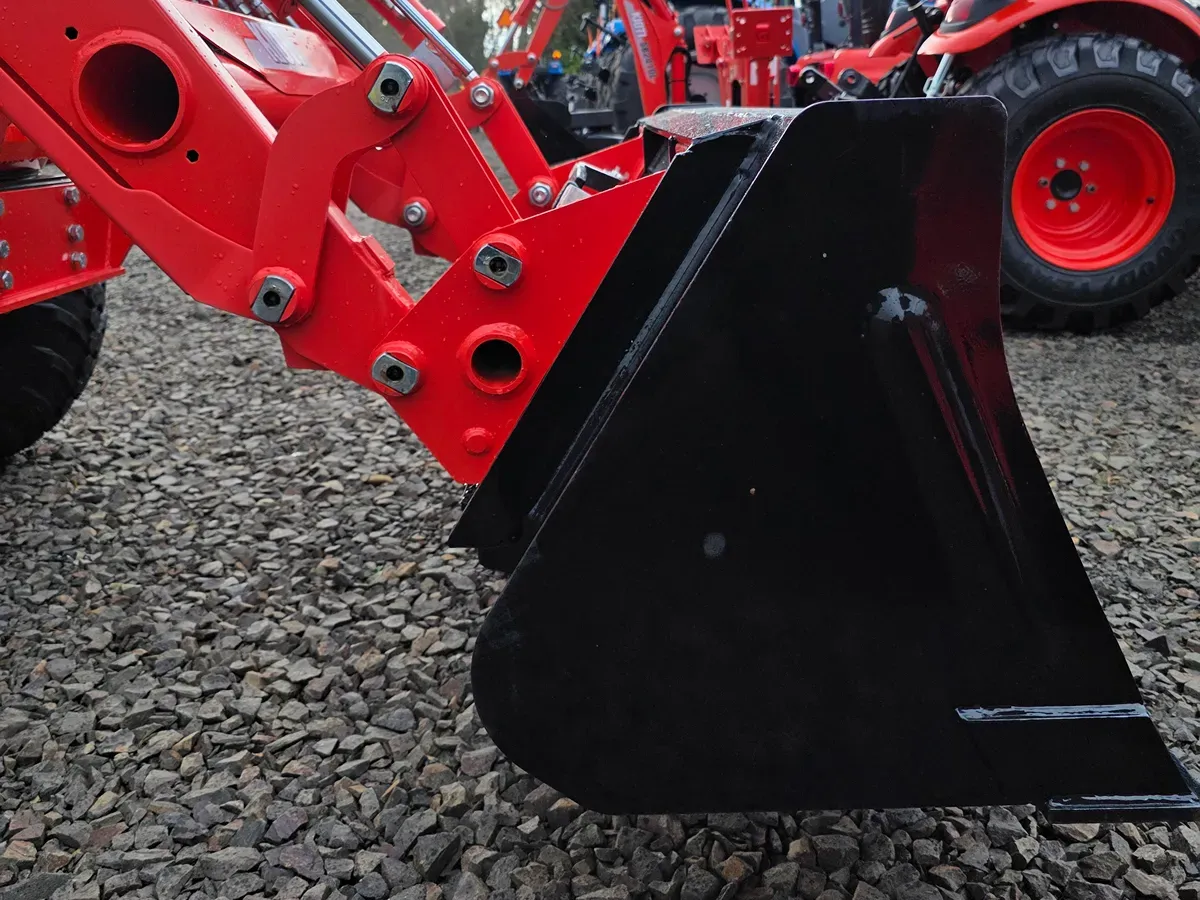
The further forward your load sits from those pins, the less you can lift. Think of it like holding a 5-gallon bucket of water at your side versus holding it with your arm stretched all the way out. Same weight, completely different effort.
Buckets keep the load center fairly close to the tractor — roughly 12-20 inches forward of the pins. In the real world, figure about 80% of the pin number at carry height.
Pallet forks push the load center out to 24-30 inches forward. Once you add the fork frame and move the load center out, most folks end up around 60% of the pin rating with standard pallet work, assuming the tractor is properly ballasted. That 1,835-lb loader? With forks and a standard pallet, you're safely handling around 1,100 lbs.
Grapples and logs can put the center of gravity 3-4 feet forward, especially with longer logs. At that distance, there are too many variables — log length, how it's gripped, load shape — to put a clean number on it. Plan for well under half of the pin rating and you won't be surprised.
Attachment | Load Center Forward of Pins | Real-World Capacity (% of Pin Rating) |
|---|---|---|
Bucket | 12–20 inches | ~80% |
Pallet forks | 24–30 inches | ~60% |
Grapple / logs | 36–48 inches | Too many variables — plan for well under half |
These are working estimates based on published manufacturer data and independent testing — not guarantees. Your setup, terrain, and ballast will shift these numbers.
Why Does the Rear End Get Light Before the Loader Maxes Out?
Here's what catches people off guard: the hydraulics usually have plenty of power to lift the load. The loader cylinders don't know the tractor is getting light in the back. They'll keep pushing.
Think of the front axle as the pivot point. Everything forward of it — loader, attachment, material — creates leverage trying to tip the tractor forward. Everything behind it — engine, transmission, rear end — keeps those back wheels on the ground. When the forward moment wins, you lose rear traction first. The back tires start spinning because there's no weight on them. In worse cases, they come off the ground entirely.
On my setup — KL7320 loader, rated at over 3,400 lbs at the pins — I picked up a 2,000-lb pallet of wood pellets when the tractor was new with no ballast. Back end got light enough that I had to put it in 4WD to back up on gravel. Started lifting a rear tire on a slight slope. That's a 3,400-lb rated loader getting pushed around by 2,000 lbs of actual load plus maybe 350 lbs of pallet forks. The math makes sense once you understand where that weight is actually sitting relative to the pins.
This Is Where It Gets Dangerous
A light rear end isn't just inconvenient — it's a rollover risk. Once those rear tires lose contact, the front axle becomes the only thing between you and a sideways tip. Add uneven ground or a slope and it happens fast. If the back end starts getting light, set the load down immediately. Don't try to power through it, don't try to back up with it, and don't raise it higher to "clear" something. Keep loads low when you're moving, stay off slopes with a full loader, and never lift higher than you need to.
Ballast helps — I ended up putting about 110-120 gallons of beet juice in the rear tires and the problem went away. But ballast lets you safely carry what the loader geometry allows. It doesn't change that geometry. A 1,835-lb pin-rated loader with perfect ballast still tops out around 1,100 lbs on forks.
Ballast Isn't Optional If You're Running a Loader
If you're doing any regular loader work — especially with forks or a grapple — your tractor needs rear ballast. Period. Filled rear tires (beet juice won't freeze or corrode your rims), a heavy 3-point implement like a box blade, or a dedicated ballast box all work. Your owner's manual lists minimum ballast for loader use and most people don't hit those numbers. Check yours before you assume you're fine.
How Do You Actually Size a Loader for Your Work?
Work Backwards From Your Heaviest Load
The sizing multipliers are straightforward once you understand load position:
Mostly bucket work? You can shop close to rated pin capacity. Dirt, gravel, and material in the bucket sit relatively close to the pins.
Regular pallet handling? You need a loader rated about 1.5x your actual pallet weight at the pins. Planning to move 1,500-lb pallets regularly? Look for at least 2,200-2,500 lbs at the pins.
Logs, totes, or awkward loads? Look for 2x your typical load weight in pin rating. The farther forward and more unpredictable the load, the more margin you need.
Questions Worth Asking
Does the manufacturer publish a 500mm-forward number? If they do, that's your more realistic starting point. If they don't, assume 25-30% less than the pin number as a baseline — and that's still measured closer to the tractor than most loads sit.
What does the tractor weigh? Loader capacity means nothing without enough tractor behind the front axle to keep you stable. A 3,400-lb tractor and a 6,000-lb tractor with the same loader will have very different real-world limits.
What are you actually lifting? This sounds obvious, but most people are thinking about their average load. Size for the heaviest thing you'll pick up regularly, not the lightest.
The Capacity You Buy Today Is the Capacity You're Stuck With
Loads get heavier over time. The pallet you're lifting today becomes the pallet-plus-a-few-bags-of-feed next year. Extra loader capacity at purchase costs a fraction of what trading up to a bigger tractor costs later. But the loader has to match the tractor — it's a system. A massive loader on a lightweight tractor just means you'll tip forward sooner.
The Bottom Line
Loader specs aren't lies. They're measured at a point where nothing actually loads. Every inch forward of those pivot pins reduces what you can safely lift, and the tractor's own weight determines how much of that reduced capacity you can actually use without losing your back end.
Size for where your load actually sits, not the number on the spec sheet. And when two loaders look similar on paper, look at the overall tractor weight and class — that tells you more about real-world capability than comparing pin ratings ever will.
FAQ
Why can't my loader lift what the specs say it should?
Loader lift capacity is measured at the pivot pins — the closest point to the tractor. Real loads on buckets, forks, or grapples sit much farther forward. Depending on the attachment, you could be working with 60-80% of the pin rating or less.
How much can my tractor actually lift with pallet forks?
As a general rule, figure about 60% of your loader's rated pin capacity when using standard pallet forks. A loader rated at 1,835 lbs at the pins will safely handle around 1,100 lbs on forks, assuming adequate rear ballast.
Does adding ballast increase my loader's lift capacity?
Ballast improves stability and lets you safely use more of your loader's existing capacity, but it doesn't change the capacity itself. The reduction from load position is a function of loader geometry — adding rear weight helps you carry what the physics allows, but it doesn't change that physics.
Why do some manufacturers show two lift capacity numbers?
Some manufacturers publish capacity at the pivot pins and at 500mm (about 20 inches) forward. The 500mm number is more realistic for bucket work. When a brand only publishes the pin number, direct comparisons between brands can be misleading.
How do I compare loader capacity between different tractor brands?
Look beyond the pin rating. Compare the overall tractor weight and class — machines in the same size category tend to perform similarly in the real world regardless of spec sheet differences. The machine class matters more than finding the best specs within a class.
Written by Jeremy Linder
I grew up on a working farm with parents who manufactured machinery. I've been selling tractors and implements since 2014, and I run my own 20 acres plus help manage our family's 200-acre beef operation. Everything I recommend is something I'd put on my own property.
Get equipment tips in your inbox
No spam. Unsubscribe anytime.